
+ × = MI MathIt Guides
Dysgraphia and maths →
EN ▾
Google Play
A guide for parents in England

Dysgraphia and maths: how support can work in England

Your child understands the maths, but the written answer comes out wrong. In England, schools have a way to help: SEN support, and for some children an EHC plan. This guide explains the steps, the adjustments that make sense in maths and how exam arrangements fit in.

K Updated: · By
In short
  1. 1Your child does not need a diagnosis or an official plan for the school to start SEN support. The class or subject teacher leads it, with the SENCo.
  2. 2SEN support is a cycle: assess, plan, do, review. Parents and the child should be involved, and a review date agreed.
  3. 3An EHC plan is a further option for children whose needs call for more than SEN support usually provides. Families and schools can talk it through together and, if it seems right, request an assessment from the local authority.
  4. 4In maths, useful adjustments change how thinking gets onto the page, such as squared paper, typing or oral answers, not what the child is expected to know.
  5. 5For GCSEs, the school applies for access arrangements under JCQ rules. They rest on evidence of need and the child's normal way of working, so what is used in lessons matters.
01

SEN support and EHC plans: what is what

In England, extra help at school comes in two steps. The first is SEN support. Every mainstream school provides it, led by the class or subject teacher together with the school's special educational needs co-ordinator, the SENCo. It does not need a diagnosis, and your child does not need an official plan to receive it.

The second step is an education, health and care (EHC) plan. It is a legal document from the local authority for children who need more support than SEN support can give. Dysgraphia is a handwriting difficulty. The SEND Code of Practice lists dyslexia, dyscalculia and dyspraxia as examples of specific learning difficulties and does not name dysgraphia. What matters is how your child's difficulty affects their learning, not which label it carries.

SEN supportProvided by the school. Teacher and SENCo analyse what is hard, agree adjustments with you and your child, and review them on a set date. It is the natural place to begin.
EHC planWritten by the local authority after an EHC needs assessment. It sets out the child's educational, health and social needs and the support to meet them, for children and young people up to 25 whose needs call for more than SEN support usually provides.

This guide describes England. The Code of Practice and the terms SENCo and EHC plan apply there; Scotland, Wales and Northern Ireland use different systems.

02

The graduated approach: assess, plan, do, review

The Code of Practice describes SEN support as a four-part cycle, known as the graduated approach. Each time round, decisions are revisited with a better understanding of what helps. For a child whose maths is held back by handwriting, it can look like this:

01AssessThe teacher and SENCo look at the child's work and progress, and draw on your views and your child's own. Bring examples where the working falls apart even though the thinking is right.
02PlanYou, the school and your child agree the adjustments, the support and what you hope will change, with a clear date for review. Parents are formally told that SEN support is being provided.
03DoThe class or subject teacher stays responsible for your child day to day, working with any support staff. The plan is shared with all staff who teach your child.
04ReviewOn the agreed date the school looks at what worked, with your views and your child's, and revises the plan. Parents are kept informed about the impact.

A useful habit: keep a written copy of the plan, with the date of the next review. It helps everyone keep track of progress together.

03

Adjustments that make sense in maths lessons

None of these lowers what your child is expected to learn. They change how the child gets their thinking onto the page. Treat the list as ideas to talk through with the teacher, who knows best what will suit your child:

✓ ≠ ✎marking the method and the answer, not the neatness of the digits,
▦squared paper or a printed grid, with larger squares if needed, so columns stay straight,
▭worksheets with space for working instead of copying questions from the board,
+ ⏱more time for written work in class,
“ ”explaining a method aloud when the written version is illegible,
▣typing or using a tablet for longer written work,
⌗a times-table grid or number-facts sheet, if recalling facts is a separate difficulty,
✂fewer questions of the same kind, so one worked example shows the skill.

Written calculations, such as column addition and bus stop division, are where handwriting costs the most marks, because a digit in the wrong column changes the answer. Our guide to written calculations goes through them step by step.

04

Years 4 to 9: from KS2 to KS3

Support does not have to be built in one go. A rough picture of how the years fit together:

Years 4–6 (KS2)Written methods grow, and so does the amount of writing. This is a good time to share what you notice, begin SEN support together and find out which tools help at home and in class.
Year 7 (KS3)A new school, a new SENCo and many teachers. The primary school can pass on what has worked, and the new SENCo can explain how it will be shared with maths teachers.
Years 8–9 (KS3)Keep a record of what your child uses and how it helps. For GCSEs, schools look back at the picture of need and the normal way of working built up across Years 7 to 9.

Primary national curriculum tests have their own arrangements, and the school handles those. If your child is approaching them, ask the class teacher what is planned.

05

GCSEs and access arrangements

Exam adjustments are called access arrangements. They are set by the Joint Council for Qualifications (JCQ) for GCSEs and other qualifications, and the school applies for them. The SENCo is the best person to talk to early about what will be useful.

JCQ's document Access Arrangements and Reasonable Adjustments, updated in March 2026 and continuing to apply in the 2026/27 academic year, makes two things clear. Arrangements rest on evidence of need, and they reflect how the candidate normally works in school. They work best when they are already part of everyday work, not new on the day of an exam.

Its worked examples include a pupil whose writing is slow but who types well: using a word processor is that pupil's normal way of working, so the SENCo can award it. Whether extra time is also needed for handwritten papers, such as GCSE Mathematics, is a separate decision that depends on assessment evidence. The document also says schools can process applications at the start of or during the first year of a two-year GCSE course, once they have a firm picture of need from Years 7 to 9.

WHAT THIS MEANS IN PRACTICE

If typing, a scribe or extra time is likely to matter at GCSE, it helps if your child already uses the same tool in lessons and mocks, and if the school keeps a record of it. JCQ's page lists the current guidance, and the SENCo can tell you what evidence your child's school will need.
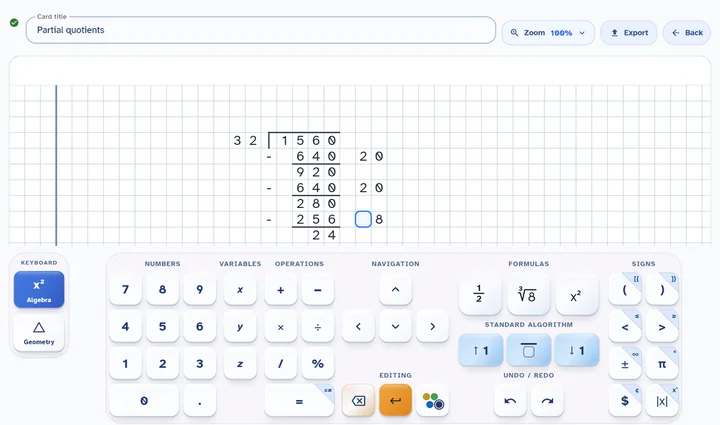
A worksheet in MathIt
06

Where MathIt helps

MathIt is a maths notebook for Android tablets, built for children who find handwriting hard. It is a squared notebook where the child picks digits and signs instead of drawing them, and the grid keeps them in place. Columns stay aligned, the decimal point stays put and a fraction looks like a fraction. For a child on SEN support, it can be one of the tools you try and describe to the teacher; whether it suits your child is for you and the school to judge.

MathIt does not calculate anything for the child and does not check answers. It only takes the handwriting out of the way, so the work shows the child's own thinking. Finished work can be exported to PDF and shown to the teacher or the SENCo.

MathIt runs on Android tablets (7-inch screen or larger), for Years 4–9 (ages 8–14), with no account and no ads.

For Android tablets
Google Play