 EN ▾
Is it the writing or the maths?
Before you start practising, work out where the problem actually sits. Otherwise it is easy to drill maths your child already understands.
Calculation by calculation: what breaks and what helps
Different written methods put different demands on handwriting. This table sets out common problems and practical fixes — these are practical suggestions, not clinical guidance, so try what actually works for your child.
Digits and symbols that get confused
When handwriting is unclear, even your child can misread their own working. The most commonly confused digits are those with a similar shape (6 and 0, 1 and 7, 4 and 9), along with operation signs. What helps:
Can squared paper help with dysgraphia in maths?
It can. A grid gives each digit a place and makes it easier to keep ones, tens, and hundreds aligned. Classroom guidance for dysgraphia commonly suggests squared paper; another simple option is to turn lined paper sideways so the lines become vertical column guides.
A note on the evidence: squared paper is often recommended by specialists and helps keep columns aligned, but it has not been tested in controlled studies. So treat it as a sensible first step and watch whether it works for your child.
Start with ordinary squared paper. If the squares feel cramped, try a large-square version. If copying the layout is the main difficulty, a worksheet with the columns already drawn may help more than changing the paper size. The useful test is whether your child can read their own working and explain where each digit belongs.
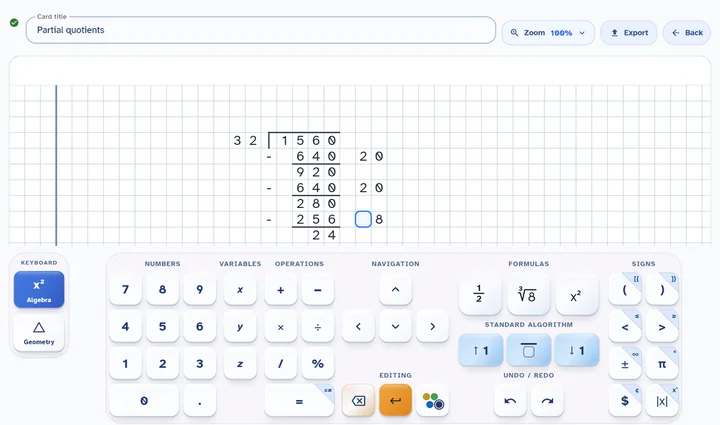
A digital grid serves the same purpose when handwriting remains the barrier: digits and symbols are selected, each step can be corrected without rewriting the page, and the finished work stays readable. A tool like MathIt should preserve your child's own method rather than calculate the answer.
What to ask the maths teacher
The standard advice for dysgraphia comes down to one principle: assess what the child knows, not how they write it. In maths lessons and tests, that usually means:
Sharing the specifics tends to work better than describing the difficulty in general terms — naming exactly what helps (columns, extra time, marking the method) makes it easier for a teacher to put in place.
If your child has SEN support or an EHC plan, check that these maths adjustments are recorded there; a private assessment is worth sharing with the school too. See our main guide for more on school adjustments.
When to ask for an assessment
If the writing difficulty persists despite practice and support at school, and your child clearly does better working things out aloud, talk to the class teacher and the school's SENCo (special educational needs co-ordinator) about an assessment, for example by an educational psychologist or a specialist teacher. In England this can lead to SEN support at school and, for more complex needs, to an EHC plan. How it works is covered in our main guide to dysgraphia.
Where MathIt helps
Many of the tips above — a grid, aligned columns, one digit per square — exist to stop the writing from drifting. MathIt does that for the child: the child does not draw digits but picks them, and the grid keeps them in place. Columns stay aligned, the decimal point stays put, and a fraction looks like a fraction.
MathIt does not calculate anything for the child and gives no answers. It only removes the obstacle of writing, so the work shows the child's own thinking. Finished work can be exported to PDF and shown to the teacher.
MathIt runs on Android tablets (7-inch screen or larger), for Years 4–9 (ages 8–14), with no account and no ads.
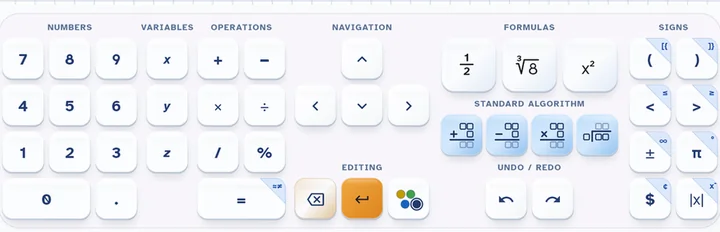
MathIt is designed for Android tablets with a screen of 7 inches or more.
Frequently asked questions
Is dysgraphia the same as dyscalculia?
No. Dysgraphia is a difficulty with the physical act of writing – the child understands the maths but the written working goes wrong. Dyscalculia affects understanding numbers and maths reasoning itself, regardless of how the child writes. This guide is only about the writing side.
Does squared paper help with dysgraphia in maths?
It can. A grid gives each digit a place and helps keep ones, tens, and hundreds aligned. Start with ordinary squared paper; try larger squares if the grid feels cramped, or a worksheet with columns already drawn if copying the layout is the main difficulty. Squared paper is often recommended by specialists, but it has not been tested in controlled studies.
What digital tools help with written calculations?
An ordinary word processor is not built for column working, so it's worth looking for a tool made specifically for written maths, where digits and symbols snap into a grid instead of being handwritten.
Sources
- MedlinePlus (U.S. National Library of Medicine) – Dysgraphia: an overview of writing difficulties and why an assessment needs to rule out other causes.
- Understood.org – Classroom accommodations for dysgraphia: squared paper or lined paper turned sideways to line up maths problems, extra time, oral answers and marking knowledge rather than handwriting
- Understood.org – Assistive technology for maths: squared paper for place value, large-square alternatives and digital maths tools
- MathIt – Dysgraphia in children: what it is, how to recognise it and how to help (assessment and school adjustments)
- GOV.UK – Special educational needs support: talking to the teacher or the SENCo (England)
This guide is for information only and does not replace an assessment or advice from a specialist. The specific tips for written calculations are practical suggestions, not clinical guidance. If you suspect dysgraphia, talk to your child's school or a qualified specialist.