
+ × = MI MathIt Guides
Dysgraphia and maths → EN Google Play
A guide for parents in England

Talking to the SENCo about dysgraphia in maths: what to bring and what to ask

You have seen your child understand a maths problem and still lose marks to messy columns. The school's SENCo is the person to talk to. This guide helps you prepare for that conversation in England, in plain terms and without needing a diagnosis first.

K Updated: · By
In short
  1. 1The SENCo co-ordinates special educational needs support in your child's school. You can ask for a meeting yourself.
  2. 2Bring two or three pages of maths where the method is right but the digits drift, and a note of how homework feels.
  3. 3Ask what the school has noticed, whether your child is on SEN support, what will be tried and when it will be reviewed.
  4. 4Afterwards, write down what was agreed and the review date. If you and the school feel more support could help, you can consider an EHC needs assessment together.
  5. 5Free help is available from your local SENDIASS, IPSEA and the British Dyslexia Association helpline.
01

Why start with the SENCo

The SENCo is the teacher in your child's school who co-ordinates support for children with special educational needs. GOV.UK suggests that for children aged 5 to 15, parents who think their child needs extra help talk to the teacher or the SENCo. In practice the SENCo is the person who can pull together what the maths teacher sees, what you see at home and what the school can offer.

Dysgraphia can look like carelessness at first glance, especially in maths, where a misplaced digit looks like a wrong answer. A short, prepared conversation helps you and the school see the pattern together, and it starts the first step of SEN support: a clear analysis of your child's needs.

02

Before the meeting: what to bring

You do not need a report to ask for a meeting. You do need a few examples that show the pattern. Pick work from the last few weeks:

✓two or three pages of maths where the method is right but digits drift out of their columns, so the answer is wrong,
✓a page of the same child explaining the same problem aloud, if you can write down what they said, so the school can compare thinking with writing,
✓a note of how long homework takes and how tired your child is afterwards,
✓anything the teacher has already said, such as comments in the book or reports,
✓any report from a specialist, if you have one, and a recent sight and hearing check if you can get it.

Write down in one or two sentences what you want from the meeting. For example: “I would like the school to look at how handwriting is affecting my child's maths, and agree what to try.”

03

Questions to ask

Nobody expects you to know the terms. These questions use the school's own language and keep the conversation practical:

01What have you noticed?Ask what the maths teacher sees, and how it compares with other children in the class.
02Is my child on SEN support?If not, ask whether the school can start the assess, plan, do, review cycle. If so, ask to see the plan.
03What will we try, and when do we review?The Code of Practice expects the adjustments, the support, the expected impact and a clear review date to be agreed with you and your child.
04How will this reach every maths teacher?Ask how the plan is shared with all staff who teach your child, and what changes in lessons and in tests.
05How will I hear about progress?Ask how and when you will get information about what is working, and how you can reinforce it at home.
06Looking ahead to examsAsk which tools your child could start using now, and how the school records that, because exam arrangements rest on how a child normally works.

Our guide to dysgraphia and maths support in England has more on the adjustments and on exams.

04

After the meeting: possible next steps

Meetings can go in several directions. Here are some things the SENCo might suggest, with friendly ways to move forward together:

“Let's keep an eye on it first.”Ask what the school will look at in the meantime and agree when you will meet again. A review date gives you both a shared plan.
“We have already made some adjustments.”Thank the school, then ask what has changed and how it is recorded, so you can build on it at home. Agree how it will be reviewed.
“This needs an assessment first.”Ask who would do it, how long it takes and whether some support can begin in the meantime.
“SEN support is the right step for now.”SEN support is the first step, and a good place to begin. Agree a review date together. If, after review, you and the school feel your child may need more, you can consider an EHC needs assessment, and GOV.UK explains the process.

After the meeting, a short email thanking the SENCo and listing what was agreed and the review date is a warm way to keep a shared record.

05

If you want more support

You do not have to work it out alone. These organisations can explain the system:

Your local SENDIASSEvery local authority in England has an information, advice and support service for parents of children with SEND. These are described as free, impartial and confidential. Search for your council's SENDIASS or use the national network page in the sources.
IPSEAA charity that gives free, independent legal information, advice and support about special educational needs in England, with guides and template letters.
British Dyslexia AssociationRuns a free, confidential helpline about dyslexia and related difficulties. Its site does not focus on dysgraphia, but the helpline may be a first step towards a local group.
EHC NEEDS ASSESSMENT

If you and the school together feel that more than SEN support may help, you can ask your local authority for an EHC needs assessment. GOV.UK explains the process, including that the authority lets you know within 16 weeks whether it will make an EHC plan. Read the GOV.UK page; your SENDIASS or IPSEA can talk it through with you before you apply.
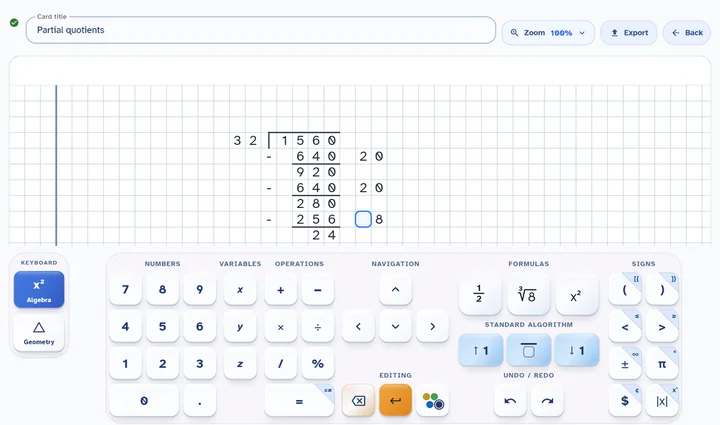
A worksheet in MathIt
06

Where MathIt helps

MathIt is a maths notebook for Android tablets, made for children who find handwriting hard. The child picks digits and signs instead of drawing them, and the grid keeps columns and fractions in place. If you and the SENCo decide to try a tablet tool, work from MathIt can be exported to PDF and shown to the teacher, so your meeting can start from your child's own thinking.

MathIt does not calculate anything for the child and does not check answers. It only takes the handwriting out of the way, so the work shows the child's own thinking. Finished work can be exported to PDF and shown to the teacher or the SENCo.

MathIt runs on Android tablets (7-inch screen or larger), for Years 4–9 (ages 8–14), with no account and no ads.

For Android tablets
Google Play