 EN
Which digits and signs should we practice first?
Start with the digits your child writes most in math: 0 to 9. The signs (+, −, ×, ÷, =, the decimal point) come next, and they appear on the layouts card.
Practice real characters, not random lines or shapes. Studies found that practicing the writing itself is what helps.
Play-dough, finger games and strength exercises are fine as a one-minute warm-up. On their own, they did not make handwriting better.
What does one practice session look like?
One session is one card, three or four different digits, and 10 to 15 minutes: look at the model, trace, write on your own, then write each digit twice from memory. Stop while it is still going well, or if the hand hurts.
The five levels. The dots fade out step by step. Each row starts with the dotted digits on the left, then empty boxes to write in.
- Level 1: trace every box.
- Level 2: trace about two thirds of the boxes.
- Level 3: trace the first two boxes.
- Level 4: trace only the first box.
- Level 5: no dots, only the model.
Move up when your child writes the digits clearly without needing the dots, not after a set number of sessions. Staying on a level, or going back one, is fine.
Flipped digits. Many young children flip the digits that face left: 1, 2, 3, 7 and 9. In studies of young children, flips were rare when they copied from a model and common when they wrote from memory. So the from-memory page is where flips show up. Flipping is common and is not a sign of dysgraphia on its own. Some NHS therapy services also list 5, and 6 written for 9. That is therapist advice, not a study result.
For refusals, tears and what to say, see Dysgraphia practice without fights.
Which free cards can I print?
All cards are free PDFs. They have no timers and no points. Every math layout is already solved, so your child only copies it.
Digits 0–4 and 5–9 are simply all ten digits on two sets, five rows per sheet. The third set, 1 2 3 7 9, holds the digits young children flip most. Each file has five level pages and a from-memory page. At Level 1 every box has a dotted digit to trace. Each level has fewer dotted boxes, and at Level 5 there are none. Start at Level 1 and move up when your child writes clearly without the dots.

Digits 0–4
Five level pages and a from-memory page for the digits 0 to 4.
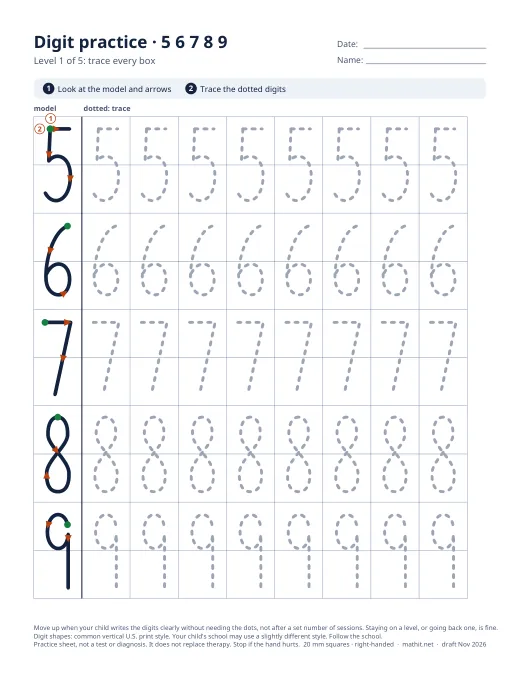
Digits 5–9
Five level pages and a from-memory page for the digits 5 to 9.
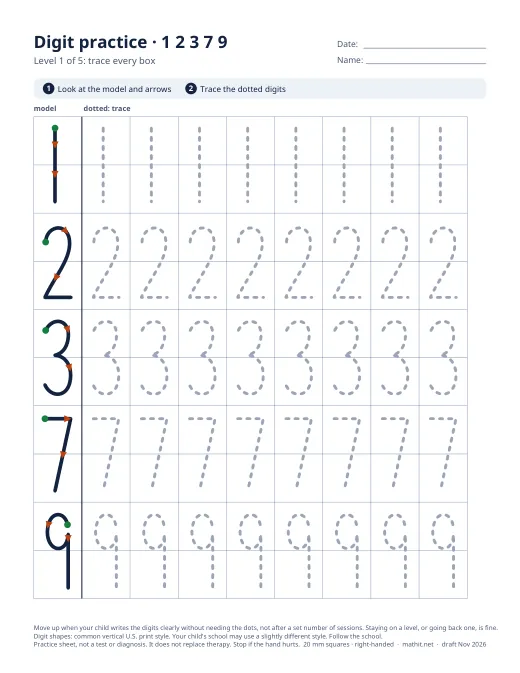
Digits 1 2 3 7 9
The digits young children flip most, with five level pages and a from-memory page.
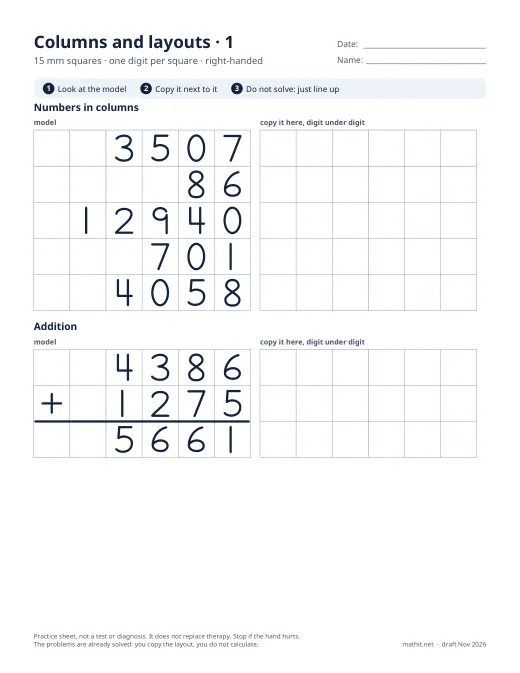
Columns and layouts
Finished problems (addition, subtraction, long division in the U.S. layout, decimals, fractions) to copy into squares, one digit per square. Nothing to work out.
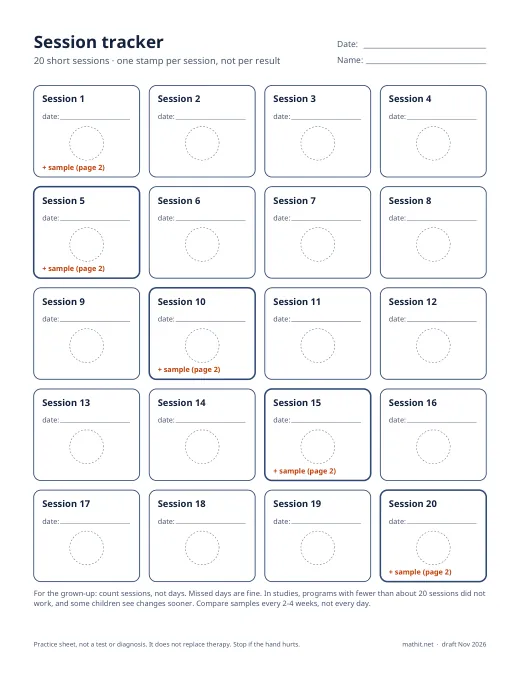
Session tracker
Twenty boxes, one stamp per session, plus sample lines to compare after sessions 1, 5, 10, 15 and 20.
Graph paper
Blank squares in four sizes (7, 10, 15 and 20 mm), each with light and bold lines.
To print: use US Letter paper at 100% (“Actual size”, not “Fit to page”). Print only the level page you need. The from-memory page is the last page of each digit file.
How are the digits shaped on the cards?
The cards use a vertical print style that many U.S. schools teach. Each model shows a green start dot and arrows.
The cards show one stroke order. We do not judge stroke order: a readable, steady digit is the goal. Your child's school may use a slightly different style. Follow the school.
My child is left-handed. What changes?
- On the left-handed cards, the model is on the right, so the writing hand does not cover it. The dotted digits still start each row from the left, like all writing.
- Put the paper to the left of the middle of the body and tilt it. Any comfortable grip is fine.
- We do not force a direction for horizontal strokes, such as the bar of a 7 or a 4. No good studies show a best direction for left-handed children.
- Ask your school OT if your child's hand cramps or tires fast.
How big should the squares be?
Start with the largest squares (20 mm, about ¾ inch) and move to smaller ones when your child says the digits fit. For how to choose, see Graph paper for dysgraphia math.
What works for dysgraphia, and what doesn't?
Parents hear a lot of advice. Here is what the research says, in plain terms.
Has research behind it
- Practicing the writing itself, with a model and arrows, then from memory. Reviews of many studies found that teaching handwriting directly made writing more legible and more fluent.
- Short, regular sessions, about 20 or more in total. In one review, programs with fewer than about 20 sessions did not help. In another, the programs that worked ran at least 6 weeks, most 12 or more.
- Practice and school support at the same time. Studies in grades 4–9 are few and small, but they point the same way.
Mixed, or too little evidence
- Weighted pencils and tablet tracing apps. The few studies are small and mixed. Try them for comfort, not instead of writing practice.
- Squares of different sizes. Nobody has studied the best size, so let your child compare two.
- Whiteboards, grid color, matte screen film. We found no studies. Pick what your child likes.
No support in the studies we know
- Hand-strength games, play-dough or mazes alone. They are fine as a one-minute warm-up. By themselves they did not make handwriting better.
- Vision therapy for learning disabilities. A joint statement by pediatric and eye doctors does not recommend it.
- Colored overlays and lenses. A review of the evidence on reading found small effects at best.
- Brain Gym, and sensory integration as a handwriting treatment. The research is thin or mixed.
- Diets and auditory training. We found no studies for handwriting.
- Writing the same letter over and over. Use a few different characters per session.
Dysgraphia does not go away with practice. Practice can make writing clearer or less tiring for many children. Your child may still need extra time, graph paper, a keyboard or a tool for math at school. Plan for both.
How we sort this: “research behind it” means reviews or trials we could read. “No support” means the studies we know do not back it. Most studies are of younger children. If a family tried something on the right-hand side, nothing went wrong. It just is not a reason to skip the practice. The sources are listed at the end.
When should we talk to the school or an occupational therapist?
- Nothing has changed after about 20 sessions.
- Your child's hand hurts or cramps.
- Most practice days end in tears.
- Math grades drop because of how the page looks, even though your child understands the math.
These are reasons to ask for help, not reasons to practice harder. See how to talk to your child's teacher and math accommodations: IEP, 504 plan and state tests.
Where does MathIt fit?
Practice trains the hand. MathIt does not replace it. MathIt takes some of the writing load off math homework. On a tablet, your child types digits on a math keyboard, each digit sits in a graph-paper square, and a finished card can be exported as a PDF.
MathIt never calculates or checks the answer.
About MathItQuestions parents ask
How long should one session be?
About 10–15 minutes, a few times a week. Use one card, and write a few different digits rather than one digit many times. Plan about 20 sessions in all, and count sessions, not days.
Are these cards too young for my fourth grader?
The cards have no cartoons or dotted-line borders. They show digits, squares and finished math layouts, so they suit grades 3–8. Older children can start at a higher level.
How do the five levels work?
Level 1 has a dotted digit to trace in every box. Each level has fewer dots, and Level 5 has none. Move up when your child writes clearly without the dots, not after a set number of sessions.
Will these exercises make dysgraphia go away?
No. Practice does not make dysgraphia disappear. Practice may make writing clearer or less tiring, and your child may still need accommodations and tools at school.
Which digit style do the cards use?
A vertical print style that many U.S. schools teach. Your child's school may use a slightly different style. Follow the school. We do not judge stroke order.
Sources
- Hoy, Egan, Feder – A Systematic Review of Interventions to Improve Handwriting, Canadian Journal of Occupational Therapy, 2011
- Santangelo, Graham – A Comprehensive Meta-Analysis of Handwriting Instruction, Educational Psychology Review, 2016
- Engel, Lillie, Zurawski, Travers – Curriculum-Based Handwriting Programs: A Systematic Review With Effect Sizes, American Journal of Occupational Therapy, 2018
- Berninger et al. 1997 – Treatment of handwriting problems in beginning writers (University of Washington news summary)
- Berninger et al. 2015 – handwriting instruction for students in grades 4–9, Computers & Education
- Cole et al. – OT intervention to address handwriting deficit: How to, how much, and how often? A scoping review, 2022
- Blank et al. – International clinical practice recommendations on developmental coordination disorder, 2019
- Joint statement: Learning Disabilities, Dyslexia, and Vision, Pediatrics, 2009
- Griffiths et al. – The effect of coloured overlays and lenses on reading: a systematic review, 2016
- Hyatt – Brain Gym, Remedial and Special Education, 2007
- American Academy of Pediatrics – Sensory Integration Therapies for Children With Developmental and Behavioral Disorders, 2012
- Fischer, Tazouti – Unraveling the mystery of mirror writing in typically developing children, Journal of Educational Psychology, 2012
- Fischer – Mirror writing of digits and (capital) letters in the typically developing child, Cortex, 2011
- Berkshire Healthcare NHS Foundation Trust – Reversing letters and numbers in writing (children's therapy advice)
- Somerset NHS Foundation Trust, Children and Young People's Therapy Service – Letter and number reversals (last reviewed September 2025)